
This Amazon KDP publishing guide explains how Kindle Direct Publishing works in 2026, including publishing costs, royalties, ISBNs, book formatting, keywords, KDP Select, distribution, and what authors should know before publishing.
Publishing a book no longer requires getting an acceptance letter from a traditional publishing house. Amazon Kindle Direct Publishing, better known as Amazon KDP, allows authors to publish their own eBooks, paperbacks, and hardcovers and make them available to readers through Amazon.
The platform itself is free to use. Authors can create a KDP account, upload their book files, set pricing and publishing information, and submit a title for sale without paying Amazon an upfront publishing fee.
However, uploading a book to KDP is not the same as professionally preparing a book for publication. Before a manuscript reaches Amazon, an author still has to make decisions about editing, proofreading, formatting, cover design, ISBNs, metadata, categories, keywords, pricing, distribution, and marketing.
This guide explains what authors need to understand before clicking the Publish button.
Table of Contents
What Is Amazon KDP?
Amazon Kindle Direct Publishing is Amazon’s self-publishing platform.
Through KDP, authors and publishers can prepare titles for sale as:
- Kindle eBooks
- Paperbacks
- Hardcover books
Instead of printing hundreds or thousands of copies before a book launches, print books sold through KDP can be produced as orders are placed. For authors, this can reduce the financial risk and storage requirements traditionally associated with maintaining a physical inventory.
KDP also gives authors control over important publishing decisions such as pricing, territories, book descriptions, categories, keywords, and available formats.
For many independent authors, Amazon can therefore become an important part of their publishing strategy.
However, Amazon is the platform through which the book is published and sold. It does not automatically perform all the professional work necessary to prepare the book itself.
Understanding that distinction is one of the most important lessons for first-time authors.
Is Amazon KDP Free?
Yes.
There is no standard upfront fee to create a KDP account or upload an eligible book for publication through KDP. Amazon itself describes KDP as a free self-publishing service.
That does not mean publishing a professionally prepared book necessarily costs nothing.
Authors may still choose to invest in services such as:
- Developmental editing
- Copyediting
- Proofreading
- Cover design
- Interior formatting
- eBook conversion
- ISBNs
- Illustrations
- Copyright registration
- Marketing
- Author websites
- Advertising
- Wider distribution
The distinction is simple:
Amazon does not charge you an upfront fee merely to use KDP, but preparing a competitive book may involve other costs depending on what you can do yourself and what you choose to outsource.
Print books also have production costs. When a paperback or hardcover sells, the applicable printing cost is deducted when Amazon calculates the royalty.
What Does Amazon KDP Actually Do?
KDP provides the infrastructure that allows authors to upload, publish, sell, and manage eligible books through Amazon.
You can use KDP to enter information such as your:
Book title, subtitle, author name, description, publishing rights, keywords, categories, manuscript file, cover file, ISBN information where applicable, territories, list price, and royalty option.
Once a book is live, the KDP Bookshelf can also be used to manage and update various elements of the title.
This makes KDP extremely useful.
But there is an equally important question.
What Does Amazon KDP Not Do for Authors?
KDP gives you publishing technology.
It does not automatically turn an unfinished or poorly prepared manuscript into a professionally produced book.
For example, KDP does not automatically provide a professional developmental editor who reviews whether your story, argument, structure, pacing, chapters, or character development are working.
It does not automatically copyedit every sentence for grammar, consistency, syntax, clarity, and readability.
It does not guarantee that your cover will compete effectively within your genre.
It does not automatically create a polished print interior or strategically position your book through professional metadata research.
And publishing through Amazon does not mean readers will automatically discover or purchase your book.
Those responsibilities remain with the author or the publishing professionals the author chooses to work with.
If your manuscript is still being prepared, learning about professional book editing before formatting and publication can prevent avoidable corrections later.
Authors can also review our guide on what professional editing fixes and what it does not before deciding what level of editing their manuscript requires.
What Do You Need Before Publishing on Amazon KDP?
Technically, KDP makes the upload process relatively straightforward.
Professionally, however, your book should be ready before you begin treating the KDP upload screen as the next step.
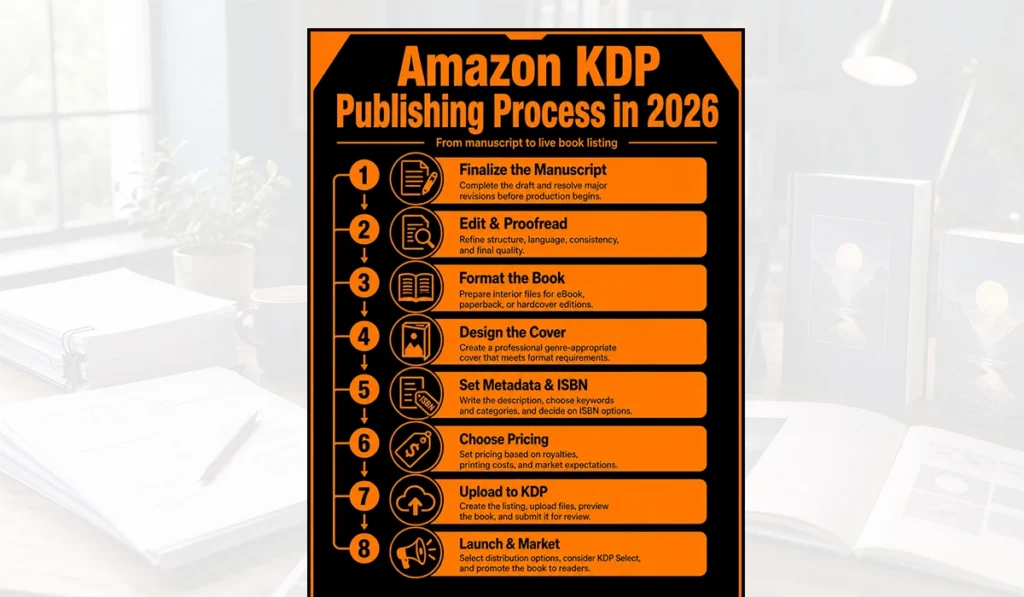
Ideally, an author should have a finalized manuscript, completed editing and proofreading, properly prepared interior files, a finished cover, a book description, appropriate metadata, a pricing strategy, a clear ISBN decision, and a plan for how the book will be distributed and marketed.
Think of KDP as the delivery system, not the production department.
1. A Finished Manuscript
The manuscript should be as close to final as possible.
Making substantial textual revisions after a book has already been formatted can create unnecessary production work.
If the book still has structural problems, unclear arguments, inconsistent characters, weak pacing, repetitive sections, grammar problems, or incomplete chapters, those issues should normally be resolved before final formatting.
2. Editing and Proofreading
Different manuscripts require different levels of editorial work.
A developmental edit addresses larger issues such as structure, organization, plot, pacing, argument, characterization, and overall effectiveness.
Copyediting focuses more closely on grammar, usage, consistency, syntax, and readability.
Proofreading is generally the final quality-control stage, checking for remaining typographical, punctuation, and formatting errors.
You can learn more about these stages through our book editing services.
3. Professional Book Formatting
A Word document that looks fine on your computer is not automatically a finished book interior.
Print formatting can involve decisions about:
Margins, trim size, typography, paragraph styling, chapter openings, page numbering, running headers, front matter, back matter, image placement, bleed, spacing, and other production details.
eBooks require different considerations because Kindle text generally needs to respond properly to changing screen sizes and reader settings.
Direct Kindle Publishing provides book formatting for paperback, hardcover, and eBook editions for authors who prefer not to prepare these files themselves.
4. A Properly Prepared Cover
Your cover has two jobs.
It has to meet the technical requirements of the format you are publishing, and it has to persuade the right reader to investigate the book.
For print editions, a full cover generally includes the front cover, spine, and back cover. Its final measurements can depend on factors such as trim size and page count.
The visual design should also make sense within the book’s genre.
A business book, children’s picture book, romantic thriller, historical novel, poetry collection, and memoir are not competing under the same visual expectations.
Authors who need professional assistance can review our book cover design services.
How to Publish a Book on Amazon KDP
If you want to know how to publish on Amazon KDP, the process begins after your manuscript, cover, formatting, metadata, and publishing decisions are ready.
You create or sign in to your KDP account, begin a new title, choose the format you want to publish, enter the book’s details, upload your manuscript and cover, preview the files, complete pricing and distribution selections, and submit the book for review.
Amazon’s official KDP Help Center provides current technical instructions for the platform.
This upload stage, however, should ideally come at the end of your book-production process rather than the beginning.
If you are still trying to understand the broader sequence from manuscript development through publication, read our complete step-by-step guide to publishing a book.
This Amazon KDP publishing guide focuses not only on the upload process but also on the preparation authors should complete before submitting a book.
How Much Does Amazon KDP Pay in Royalties?
KDP royalties depend on the book format, marketplace, list price, printing costs, and applicable royalty option.
The number an author receives is not simply the retail price of the book.
Kindle eBook Royalties
Amazon currently provides two primary eBook royalty options:
35% and 70%.
The 70% option has additional eligibility requirements and delivery costs can apply. Sales outside territories eligible for the 70% option may receive the 35% rate even when the book is otherwise enrolled in the 70% plan.
Authors should therefore use Amazon’s current pricing documentation rather than assuming every Kindle sale automatically produces a 70% royalty.
Important 2026 Change to Amazon KDP eBook Pricing
Amazon made a notable change to its eBook pricing structure on July 7, 2026.
On Amazon.com, the list-price band for the 70% eBook royalty option expanded from the previous maximum of $9.99 to a new range of:
$2.99 to $12.99.
Equivalent changes were introduced in other KDP marketplaces. Amazon states that the minimum $2.99 price for this U.S. band remains unchanged.
This change gives authors more flexibility when pricing higher-value Kindle books while potentially remaining within the 70% royalty band, provided all other requirements for the royalty option are met.
That can be particularly relevant for longer nonfiction books, specialized educational titles, reference books, professional material, and other publications for which a price above $9.99 may make commercial sense.
Authors should still avoid setting a price simply because a higher price is now permitted.
A useful pricing strategy considers:
Reader expectations, competing books, genre, format, page count, author reputation, perceived value, launch objectives, and royalty economics.
Paperback Royalties on Amazon KDP
For paperback books sold through supported Amazon marketplaces, KDP currently uses 50% or 60% royalty rates depending on the applicable list price, after which printing costs are deducted.
For Amazon.com, Amazon’s current documentation shows the 60% tier beginning at a list price of $9.99, while eligible paperbacks priced at or below $9.98 fall under the 50% tier.
The basic calculation is:
Royalty rate × list price − printing cost = estimated royalty
Printing costs can be affected by factors including page count, trim size, ink type, and marketplace.
This is why page count and formatting can affect more than aesthetics.
A very long book may cost more to manufacture, which can affect both the minimum viable retail price and the author’s royalty per sale.
Amazon provides a Printing Cost and Royalty Calculator for estimating print economics before publication.
Hardcover Royalties on Amazon KDP
KDP also currently applies 50% and 60% royalty rates to hardcover books in supported marketplaces, depending on the title’s list price.
Printing costs are then deducted when royalties are calculated.
Hardcovers usually cost more to manufacture than paperbacks, so authors should consider whether the format fits their audience and pricing strategy rather than automatically creating every available edition.
For certain books, a hardcover can add perceived value.
For others, a lower-priced paperback may be more important commercially.
Do You Need an ISBN for Amazon KDP?
The KDP ISBN decision depends partly on whether you plan to publish only through Amazon or want greater control over your publishing imprint and wider distribution.
Amazon states that ISBNs are required for standard paperback and hardcover publication through KDP, while Kindle eBooks do not require an ISBN for KDP publication.
For qualifying print books, authors can generally choose between using a free KDP ISBN or providing an ISBN they obtained independently.
Free KDP ISBN vs. Your Own ISBN
KDP’s free ISBN can be convenient, especially for an author whose primary goal is simply to publish a print edition through Amazon.
However, there are important differences.
Amazon states that its free ISBN can only be used through KDP and that books using the free KDP ISBN display the imprint as “Independently published.”
If an author obtains an ISBN independently, the author or publisher can instead register the ISBN using the appropriate publishing or imprint information.
For U.S. publishers and self-publishing authors purchasing their own ISBNs, ISBNs are available through Bowker’s MyIdentifiers service.
Neither choice is automatically right for every author.
A free ISBN may be perfectly reasonable for one project.
An author building an imprint, publishing multiple titles, planning broader distribution, or wanting greater control over publisher identity may prefer to obtain independent ISBNs.
For a more detailed explanation, read our guide to ISBNs, copyright, and book distribution in the United States.
Amazon KDP Keywords: How Readers Find Your Book
Publishing a book does not automatically make it discoverable.
When setting up a title, KDP allows authors to provide up to seven keywords or short keyword phrases to help describe the book and improve relevant discovery.
The operative word is relevant.
Keywords should reflect what real readers might search for when trying to find a book like yours.
For fiction, useful keyword concepts can involve elements such as setting, character type, plot themes, genre combinations, and tone.
For nonfiction, useful phrases may reflect the reader’s problem, subject matter, profession, desired outcome, skill, or area of interest.
For example, a broad keyword such as:
leadership
may provide less context than a more specific phrase such as:
leadership skills for new managers
Specific phrases can help communicate more accurately what the book is about.
Amazon also warns authors against misleading or inappropriate metadata practices, including unauthorized references to other authors or titles and promotional claims that do not belong in metadata.
Keyword research should therefore focus on relevance, not manipulation.
Choosing Amazon KDP Categories
Categories help Amazon understand where a book belongs within its catalog and can help readers encounter books while browsing relevant subject areas.
Amazon describes KDP Categories as an important discovery mechanism for books.
The best category is not necessarily the category with the least competition.
It should accurately represent the book.
A misleading category might temporarily place a book beside weaker competition, but it can also place the title in front of readers who have little interest in buying it.
For authors, the better question is:
Where would the ideal reader logically expect to find this book?
That is the foundation of effective category selection.
Professional publishing and distribution preparation can also include assistance with metadata, descriptions, keywords, categories, and publication setup.
What Is KDP Select?
KDP Select is an optional Amazon program specifically for Kindle eBooks.
Amazon currently describes KDP Select as a free 90-day program. When a Kindle eBook is enrolled, it is automatically included in Kindle Unlimited and may become eligible for selected promotional opportunities.
That sounds attractive, but authors should understand the tradeoff.
KDP Select Requires eBook Exclusivity
During the 90-day KDP Select enrollment period, Amazon requires the Kindle eBook’s digital edition to remain exclusive to the Kindle Store, subject to Amazon’s applicable terms and exceptions. Amazon states that authors can continue distributing other formats, such as print, audio, and video, elsewhere during that period.
This creates a strategic choice.
One author may prefer to concentrate Kindle readership through Amazon and Kindle Unlimited.
Another may prefer wide eBook distribution, making the eBook available through additional retailers and reading platforms.
There is no universal answer.
The right choice depends on audience behavior, genre, existing readership, marketing plans, and the author’s long-term distribution strategy.
What Is Kindle Unlimited for Authors?
Kindle Unlimited is Amazon’s subscription reading program.
Readers pay a subscription fee and can access eligible Kindle books within the Kindle Unlimited catalog.
When an author enrolls an eBook in KDP Select, that eBook is automatically included in Kindle Unlimited. The book can still remain available for individual Kindle purchase while enrolled.
Instead of receiving the normal retail royalty for a Kindle Unlimited borrow, participating authors can earn from the KDP Select Global Fund based on qualifying pages read under Amazon’s current rules.
For some genres, especially those with readers who consume books frequently through subscription services, Kindle Unlimited can form an important part of the publishing strategy.
For other books, wider digital distribution may be preferable.
Is Amazon Distribution Enough?
Amazon is one of the world’s most important online bookselling channels.
But Amazon availability and broad book distribution are not identical.
Authors may also want their books positioned for potential availability through other retailers, wholesalers, libraries, digital stores, or international channels.
The correct strategy depends on the book.
An author focused primarily on Amazon sales may decide that KDP meets most immediate needs.
Another author may want to consider additional distribution options from the beginning.
If wider availability is part of your goal, read more about book distribution beyond a single platform.
It is also important to understand the difference between availability and physical bookstore placement.
Making a book available through distribution channels does not guarantee that a bookstore will stock copies on its shelves. Retail placement can involve separate commercial decisions.
Common Amazon KDP Mistakes First-Time Authors Make
KDP makes publishing accessible, but accessibility can encourage authors to move too quickly.
Some of the most damaging problems occur before the upload itself.
Publishing the First Draft
Finishing a manuscript feels like reaching the finish line.
Usually, it is not.
A completed first draft may still contain structural issues, repeated information, continuity problems, weak pacing, grammar errors, inconsistent character details, unnecessary chapters, factual gaps, or unclear arguments.
Publishing before editing can make those problems permanent parts of the reader experience.
Designing a Cover Without Researching the Genre
A cover can be attractive and still be commercially ineffective.
Readers often use visual cues to identify genre almost instantly.
If a psychological thriller looks like a romance novel, or a business book looks like a children’s workbook, the problem is not necessarily artistic quality.
It is positioning.
Before designing your cover, study current successful titles that target a comparable audience.
Formatting a Print Book Like a Word Document
Book interiors involve decisions that ordinary documents do not.
Poor spacing, inconsistent fonts, awkward chapter openings, incorrect margins, badly positioned page numbers, unnecessary blank pages, and image-resolution problems can make an otherwise strong manuscript appear amateur.
Choosing Keywords Based on Guesswork
Authors naturally know what their book is about.
That does not automatically mean they know how readers search for it.
Good metadata connects the language of the book with the language of its intended audience.
Selecting Categories Because They Look Easy to Rank In
Categories should represent the book accurately.
A temporary category rank means little if the people browsing that category are not interested in the book.
Pricing Without Checking Production Costs
Print royalty economics can change significantly according to page count, format, and manufacturing costs.
Authors should review estimated royalties before committing to a retail price.
Assuming Publishing Creates Marketing
This may be the most common misconception of all.
Publication creates availability.
Marketing creates awareness.
The two are not interchangeable.
Authors should start considering audience, positioning, launch strategy, reviews, promotional materials, social media, outreach, advertising, and author branding before the publication date whenever possible.
Our guide to book marketing services explains some of the areas authors can consider when planning a launch.
DIY KDP Publishing vs. Professional Publishing Assistance
Many authors can publish through KDP entirely on their own.
Amazon provides the platform and documentation necessary to do so.
The real question is not whether DIY publishing is possible.
It is:
Which parts of the publishing process can you confidently complete to a professional standard yourself?
An experienced graphic designer may be perfectly comfortable producing a cover.
A professional editor may be capable of handling much of the editorial preparation independently.
An author experienced with book production may know exactly how to prepare print and eBook files.
Someone publishing a first book may prefer professional assistance with several stages.
Neither approach determines whether someone is a “real author.”
Publishing is a production process, and authors can choose which parts to manage personally and which parts to delegate.
Direct Kindle Publishing helps authors with editing, design, formatting, publishing preparation, distribution, and marketing services when professional support is needed.
Amazon KDP Pre-Publishing Checklist
Before submitting your book, ask yourself:
Manuscript: Is the text genuinely final? Has it received the appropriate editing and proofreading?
Cover: Does the design fit the genre? Does the file meet the technical specifications for the selected format?
Interior: Has the manuscript been properly formatted for paperback, hardcover, or eBook?
Title information: Are the title, subtitle, author name, and contributor details consistent?
Description: Does the book description clearly communicate what the reader will receive?
Keywords: Have relevant reader-focused phrases been selected rather than generic guesses?
Categories: Do the selected categories accurately represent the book?
ISBN: Does the book require one, and have you chosen between the available ISBN options intentionally?
Pricing: Does the list price make sense for both the market and the royalty structure?
Distribution: Will Amazon be the primary channel, or do you intend to distribute more widely?
KDP Select: If enrolling an eBook, do you understand the 90-day digital exclusivity requirement?
Marketing: Do you have a plan for helping readers discover the book after publication?
If several of those answers are still unclear, the book may not be ready for upload yet.
And that is fine.
Correcting the publishing structure before launch is generally easier than trying to rebuild it after readers have already begun purchasing the book.
A useful Amazon KDP publishing guide should help authors understand both the platform itself and the publishing decisions that come before and after uploading a book.
Frequently Asked Questions About Amazon KDP
Is Amazon KDP really free?
Yes. Amazon KDP does not charge a standard upfront fee simply to create an account and publish an eligible eBook, paperback, or hardcover through the platform. Authors may still incur separate production, professional-service, ISBN, marketing, or other costs depending on how they prepare and promote their books.
How much does Amazon KDP take from book sales?
It depends on the book format and applicable royalty structure. Kindle eBooks generally use 35% or 70% royalty options, subject to eligibility rules. Paperbacks and hardcovers sold through supported Amazon marketplaces can currently use 50% or 60% royalty rates depending on price, with printing costs deducted for print books.
Can I publish on Amazon without a publisher?
Yes. KDP is specifically designed to allow authors and independent publishers to self-publish books.
Do I need an ISBN for Kindle?
A Kindle eBook does not require an ISBN for publication through KDP. Standard paperback and hardcover editions require ISBNs, with qualifying authors generally able to use a free KDP ISBN or provide their own.
Can I use a free KDP ISBN somewhere else?
Amazon states that a free ISBN supplied by KDP can only be used through KDP.
What publisher name appears with a free KDP ISBN?
Amazon currently states that the imprint for books using its free KDP ISBN appears as “Independently published.”
How many keywords can I enter on KDP?
Amazon currently allows authors to enter up to seven keywords or short keyword phrases.
Is KDP Select mandatory?
No. KDP Select is optional.
Authors should review the benefits and exclusivity requirements before enrolling.
Can I sell my eBook elsewhere if I join KDP Select?
During a KDP Select enrollment period, the Kindle eBook must meet Amazon’s digital exclusivity requirement. Amazon states that the 90-day restriction applies to the Kindle eBook, while formats such as print and audio may continue to be distributed elsewhere.
Does publishing on Amazon guarantee book sales?
No.
KDP can make a book available for purchase, but availability does not guarantee visibility, reader interest, reviews, rankings, or sales.
Those outcomes can be influenced by the quality and appeal of the book, genre demand, positioning, cover, metadata, pricing, existing audience, reviews, marketing, advertising, competition, and numerous other factors.
Final Thoughts: KDP Makes Publishing Accessible, but Preparation Still Matters
Amazon KDP has removed many of the technical and financial barriers that once prevented independent authors from bringing books to market.
That is a major advantage.
An author can now finish a manuscript and potentially reach readers without securing a traditional publishing contract or financing a large print run.
But easier access to publication has not removed the need for professional preparation.
Readers still judge the writing.
They still notice editing mistakes.
They still respond to covers.
They still expect readable formatting.
They still make purchasing decisions based on descriptions, reviews, positioning, price, and perceived value.
And they cannot buy a book they never discover.
The most useful way to think about KDP is therefore not as the entire publishing process, but as one powerful component of it.
Write the book carefully. Edit it properly. Package it professionally. Understand your publishing choices. Then use the platform that best supports your goals.
If you have completed a manuscript but are unsure whether it is ready for publication, Direct Kindle Publishing can review your project and help identify the editing, design, formatting, publishing, distribution, or marketing preparation it may still require.
Request a free publishing consultation
Direct Kindle Publishing is an independent publishing services company and is not owned by, affiliated with, endorsed by, or a direct associate of Amazon.com, Inc. or Kindle Direct Publishing (KDP). Amazon, Kindle, and Kindle Direct Publishing are trademarks associated with their respective owner.